Business plan
Each stall can turn a cost into income.
The Horse Stall Theory · Adam Thompson · Breckenridge, Colorado · August 2026
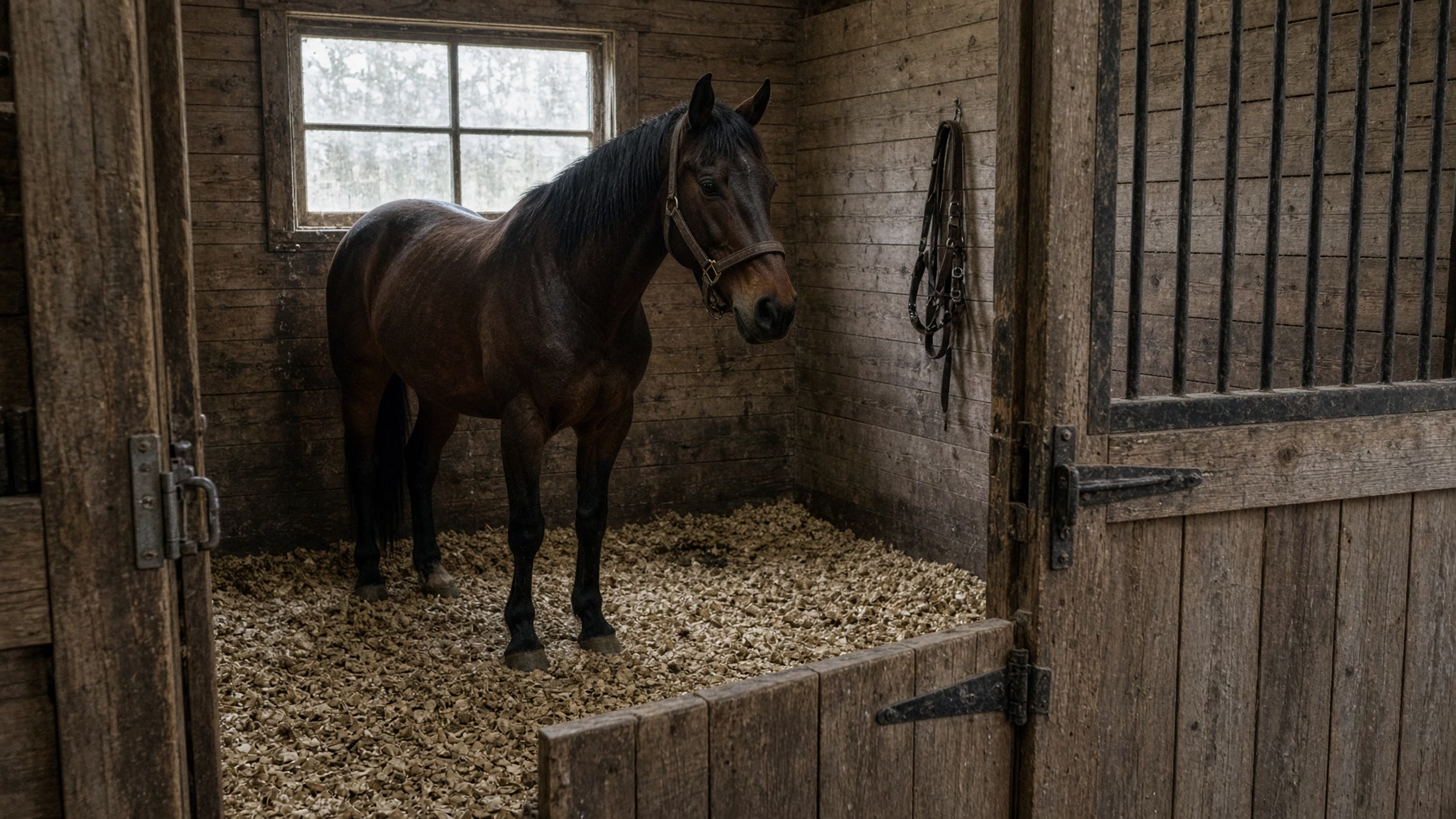
Haulers and composters often refuse wood bedding. Hemp hurd, the woody core of the hemp stalk, holds more liquid, composts faster, and can be sold as a soil product. The stall stops being only a cost.
The stall waste haulers and composters refuse
A stalled horse produces 12 to 13 tons of manure and soiled bedding a year. Pine shavings and sawdust turn that pile into a persistent waste-management problem. High lignin means they compost slowly — commonly six to twelve months or longer. During decomposition they can lock up nitrogen in soil and cut fertility. University extension and manure-management literature consistently note that many composters, mushroom growers, and some commercial haulers therefore prefer or only accept straw-based manure. The practical result is disposal friction, occasional load rejection, and a cost center instead of a revenue stream.
That is the sawdust band. The bag looks cheap. The truck does not. This is a national hauler problem — the same chemistry shows up at tracks, training centers, and boarding barns.
Saratoga Springs — the track already writes the bedding rule
On August 19, 2026, Racing Secretary Peter Iovino at Saratoga Casino Hotel confirmed it in writing: shavings only, because haulers will not take sawdust. The 2026 stall application already stated twice: “All horses stabled at Saratoga Casino Hotel must use track required bedding.” Running Aces in Minnesota requires prior approval for anything other than straw or shavings.
Saratoga Harness is the year-round backside in Saratoga Springs — eleven months, not a forty-day meet. The stall is a cost center with no clean market for wood waste. Hemp hurd composts cleanly and can be sold as soil instead of rejected as a load. That is why this works at Saratoga first: the rule is written, the hauler has spoken, and hemp is the cost-positive bedding that can satisfy a track-required program.
Hemp hurd reverses the economics
Peer-reviewed and industry absorbency tests show hemp can hold roughly four times its weight in liquid, versus about two to two-and-a-half times for many pine shavings. It produces less respirable dust, binds ammonia more effectively, and composts cleanly in six to nine months under proper management. The finished manure becomes a premium, nutrient-rich compost sold to farms, nurseries, and landscapers — a disposal cost turned into a product.
Traditional pine-shavings programs at serious racing and training operations frequently total $1,500–$3,000 or more per stall per year when material, daily labor, and hauler fees are included. Hemp hurd carries a higher unit price at current volumes. Three offsets change the math: lower volume because of higher absorbency (a 20–40% material reduction in comparative trials is realistic); reduced labor for mucking; and compost revenue in the $20–$60 per cubic-yard range depending on market and quality.
After a transition period, $1,081 net per stall per year versus pine (conservative 12×12 ledger) is the case this app books. Exact figures depend on local hauler rates, labor, and compost demand — all of which can be measured in a controlled pilot on a single farm or track. The key point is that the waste problem itself becomes the profit center that offsets the higher initial bedding cost. Convert the stall, and it is a net profit generator.
Healthier stalls, healthier horses
Respiratory health is a documented limiting factor in racehorse performance and longevity. Fine dust from conventional bedding contributes to inflammatory airway disease. Lower-dust alternatives improve air in the stall and shedrow. Hemp hurd’s absorbency and lower respirable particle load address this directly. Cleaner, more consistent conditions support recovery between works and races — a practical advantage for any serious racing or training operation. The same material serves sport horses, boarding stables, and livestock.
The gate that must open first
Nothing commercial scales at the racetrack until HISA’s near-zero tolerance for cannabinoids is clarified for environmental exposure. Trace positives linked to bedding have already occurred. The primary body is the Horseracing Integrity and Safety Authority and its Anti-Doping and Medication Control program.
Independent science already exists. Dr. Joseph J. Wakshlag at Cornell has published peer-reviewed pharmacokinetic and safety data showing that chronic CBD/CBDA administration in horses produces no clinically relevant adverse effects on blood chemistry, liver function, or other measured parameters. That work supports a reasoned case for distinguishing low-level environmental contact from intentional administration. Focused engagement with HISA is the necessary first step. Commercial adoption at the track follows only after that clarity.
How this becomes an industry
A single major owner or a small coalition can fund the regulatory work and run controlled pilots. Successful pilots generate the data for broader track adoption. Once regulatory clarity and early commercial volume exist, unit cost falls. The same bedding that solved a waste problem at the track then becomes accessible to sport-horse, dairy, beef, and companion-animal markets. Elite racing demand for hurd is large enough to justify regional processing. Increased acreage lowers cost for every other animal sector and opens secondary markets — hempcrete, textiles, seed, premium compost.
This overview is offered without expectation of personal financial gain. If it resonates, the next step is a conversation and an internal review. If it does not, it can be set aside.
After the story — one 12×12 vs the sawdust band
| Line | Pine shavings / sawdust | Hemp hurd (Dakota multi-pallet) |
|---|---|---|
| Material / year | $697 | $176 |
| Labor | $1,643 | $1,232 |
| Waste hauled | 10 cy | 6.0 cy |
| Compost | 2–3 years | 6–9 months |
| Ongoing net vs incumbent | — | $1,081 / stall |
Documented benefits across the value chain
Stall environment: high liquid absorbency (about 4× weight), reduced dust, ammonia binding, faster composting (6–9 months), lower labor, reduced fly pressure.
Animal welfare and performance: cleaner air and reduced respiratory irritation support consistency.
Soil and compost: hemp-manure compost returns nutrients without the nitrogen immobilization common with wood. Finished product is a saleable commodity rather than a disposal liability.
Crop and water: industrial hemp in rotation improves soil structure and is relatively efficient with water compared with many conventional fiber or grain crops.
Feed pathway: hemp seed ingredients have received FDA GRAS determinations for human food. Limited livestock feed pathways (hempseed meal and oil) have been accepted under self-affirmed GRAS in certain states for specific species and inclusion rates.
Scale economics: elite racing and training demand for hurd is large enough to justify regional processing. Increased acreage lowers unit cost for every other animal sector.
Four businesses from one stall
I. Bedding offtake — the trainer, backside superintendent, or private barn pays. Convert from the sawdust band; the stall becomes a net.
II. Regional mills — grower offtake plus mill equity. Steel after the letter. Site at fiber acres × horse density × racetrack backside. Running mill: Dakota Hemp, South Dakota.
III. Spent-hurd compost — the farm that already hauls. Landfill is the competitor. $20–$60 per cubic yard for finished premium compost is real product revenue.
IV. Industrial stack — bast, hempcrete, grain. After the stall has paid for the acre. Stay industrial. P.L. 119-37 keeps that lane open.
Sequence
1. Run a 90-day pilot in barns that are not tested. Contract a hauler and a composter. Start with cleaned, bagged hurd. Prove the books, then racing.
2. Clarify HISA environmental-exposure rules for industrial hemp hurd. Nothing at the racetrack scales before that gate. Residue studies first.
3. Sign offtake where bedding is already track-required — Saratoga Casino Hotel first. Write hemp hurd into the buyer’s stall order. Price on the Dakota ladder.
4. Site mill capacity only after the letter. Keep the product industrial: bedding, compost, hempcrete, bast, grain. The stall is the beachhead. The plant is the industry.
What this document will not do
It will not treat estimated track stalls as counted. It will not skip HISA. It will not sell the upside case as the headline. $1,081 net per stall per year versus pine is the conservative 12×12 ledger, not a guarantee. The stall ledger in this app uses Dakota Hemp’s published bag schedule. Exact figures belong to a pilot.
Opportunity Overview, Hemp Hurd Bedding — Adam Thompson, Breckenridge, Colorado, August 2026. Saratoga Casino Hotel racing secretary, written confirmation August 19, 2026: shavings only; haulers will not take sawdust. 2026 Stall Application (stated twice: “All horses stabled at Saratoga Casino Hotel must use track required bedding.”). Running Aces (MN) prior-approval rule. Absorbency, composting timelines, and cost ranges from published industry and university sources, intentionally conservative. 12–13 tons manure and soiled bedding per stalled horse per year (extension / manure-management literature). HISA ADMC near-zero cannabinoid tolerance; Wakshlag (Cornell) peer-reviewed equine CBD/CBDA pharmacokinetics. Dakota Hemp published bag schedule used in the stall ledger. P.L. 119-37.